Clinflash's Cutting-Edge Research Debuts at PharmaSUG 2026: AI Lightweight Solution Empowers Clinical Research




Clinflash's Cutting-Edge Research Debuts at PharmaSUG 2026: AI Lightweight Solution Empowers Clinical Research
Recently, the Clinflash statistics team published a technical paper at PharmaSUG 2026 titled "Automated Clinical Text Classification with Robust Machine Learning for Pharmaceutical Data Curation," innovatively proposing an automated annotation method for clinical trial table datasets based on a lightweight machine learning model, providing a more efficient, accurate, and one-click deployable automation solution for the annotation step in statistical programming workflows.
In clinical trial statistical programming, every Table of Contents (TOC) file requires matching table titles to corresponding CDISC ADaM dataset labels (such as ADSL, ADAE, ADLB). For a long time, this work has relied heavily on SAS programmers making judgments one by one, taking 30 to 60 minutes for a typical study. Moreover, different programmers sometimes have divergent interpretations of the same title, making it difficult to fully unify annotation results. When the number of parallel studies increases to dozens, such repetitive labor often becomes an invisible bottleneck dragging down the overall efficiency of statistical programming.
Facing the dual requirements of efficiency and consistency, the Clinflash statistics team, proceeding from actual business needs, proposed a more lightweight and controllable technical path. Two-Step Intelligent Annotation: From Model Training to One-Click Output
Relying on 14 complete clinical studies and 1,849 real annotation records (covering 60 CDISC dataset labels), the Clinflash statistics team designed a lightweight machine learning model based on TF-IDF text vectorization plus logistic regression classification. By learning the correspondence patterns between table titles and CDISC dataset labels, the model can automatically match the most suitable ADaM dataset for new tables.
The entire workflow is divided into two steps:
1. Training Phase
The model extracts the TITLE (title) of tables and manually annotated DATASET (dataset labels) from historical TOC files as training samples. Through the TF-IDF algorithm, Chinese table titles are converted into numerical feature vectors, which are then fed to a logistic regression classifier to learn the mapping relationship between title text and dataset labels. The entire process takes less than 2 seconds on a standard laptop CPU.
2. Prediction Phase
When a user submits a new, unannotated TOC file, the model automatically identifies each table title, predicts the most matching CDISC dataset label based on the patterns learned during training, and fills it into the corresponding position. For a new file containing hundreds of tables, prediction is almost instantaneous.
More critically, the entire tool is packaged as a standalone Windows program (.exe) that requires no Python environment installation and runs with a double-click. Users need no in-depth knowledge of programming or machine learning; they simply select the TOC file to be processed, and the program automatically completes the prediction and generates an Excel file with annotation results for statistical programmers to quickly review.
AI Empowerment: Returning Statistical Work to Core R&D
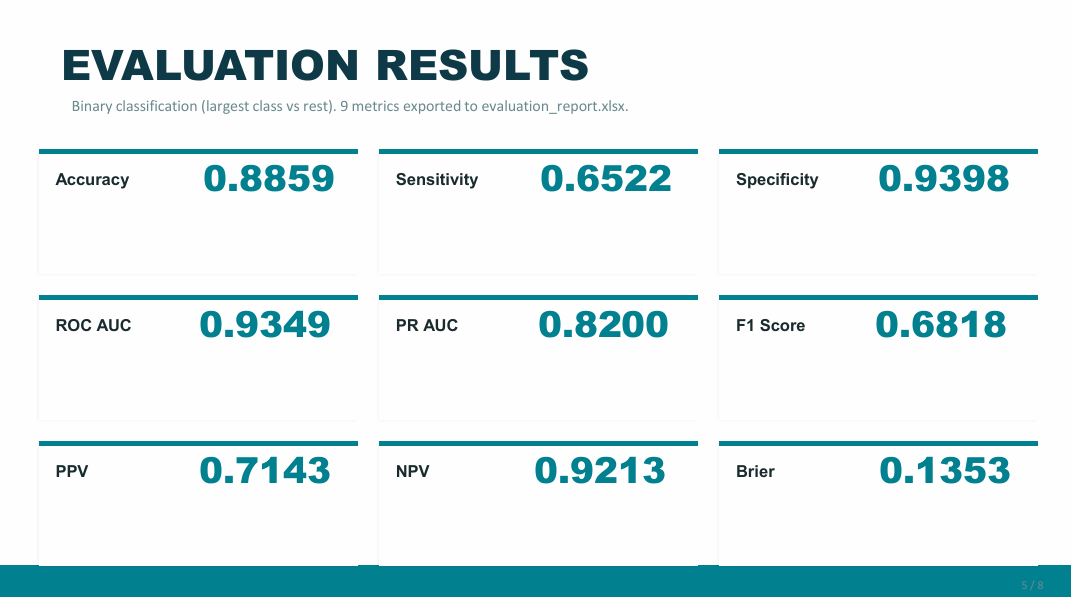
To comprehensively verify the reliability of this solution, the Clinflash statistics team systematically validated the tool under a binary classification evaluation framework, focusing on the risk of mislabeling in actual business scenarios. The results show that the tool performs very robustly after being integrated into daily statistical programming workflows:
Overall prediction accuracy of 88.59%, with controllable global annotation error rate;
ROC-AUC of 0.934, demonstrating outstanding ability to distinguish different CDISC datasets;
Specificity of 93.98%, greatly reducing the risk of misclassifying safety datasets (ADAE, ADLB) and avoiding submission hazards;
PR-AUC of 0.820, maintaining stable recognition performance in clinical labeling scenarios with imbalanced samples.
After deploying this tool, data entry work can achieve comprehensive upgrades across three dimensions: timeliness, standards, and manpower:
Efficiency Revolution: TOC annotation time per project reduced from 30-60 minutes to less than 10 seconds, freeing up statistical programming team manpower to focus on data review and high-value analysis;
Unified Standards: The model provides deterministic annotation results, avoiding inconsistency across personnel and projects, and improving data standardization;
Low-Threshold Implementation: The lightweight architecture requires no additional operational costs and seamlessly integrates with existing CDISC delivery SOPs, truly "letting technology adapt to people."
As another cutting-edge academic achievement of Clinflash in the field of AI-driven clinical R&D, this solution not only systematically validates the feasibility and reliability of lightweight machine learning methods in clinical data annotation scenarios, but also lays a solid practical foundation for the company to subsequently expand more automated AI technology applications, continuously simplifying CDISC standardized delivery processes with efficient, auditable intelligent technology.
In the future, Clinflash will continue to deepen its exploration of AI applications in clinical research, actively participate in industry exchanges, and contribute to the efficient advancement of various clinical trials and the high-quality development of the biopharmaceutical industry through more innovative and practical cutting-edge technological explorations and practices.
 Previous page
 Home Page
 Next page